
-


Subscribe by Email
Popular Posts
Category Archives: picture books for pairing
picture books on shadows
THE PAIR:
The Black Rabbit by Philippa Leathers
&
Hans and Matilda by Yokococo.
 The Black Rabbit is a hilarious shadow story, and I’m not giving much away by saying that.
Clever kids will quickly figure out who’s really following that little white rabbit, but it’ still fun to see him finally figure it out.
I love, too, that the once foreboding black rabbit is actually benevolent and helpful when white rabbit is in trouble. It’s like we need those shadow selves; at times they come in handy!

 Hans and Matilda is a shadow story as well, but in a different way.
Matilda was a good little cat; Hans was a naughty little cat.
“They were SO different!”
And they were different, like night and day really. But the thing is, and I don’t want to completely give it away, but I’m going to . . . [SPOILER ALERT]:
Hans and Matilda are the same cat! I love how this speaks to the different facets of ourselves and I think it’s something children can really relate to: being so good sometimes and so naughty sometimes but still being the same person. (Adults are sure to appreciate that too.)

Thanks to Candlewick for the images!
MATILDA AND HANS. Copyright © 2012 by Yokococo. Reproduced by permission of the publisher, Candlewick Press, Somerville, MA on behalf of Templar Publishing, UK.
THE BLACK RABBIT. Copyright © 2013 by Philippa Leathers. Reproduced by permission of the publisher, Candlewick Press, Somerville, MA.
/ / / / / / /
So … shadows and shadow play! How fun is this!
TO ADMIRE/EMULATE


Su Owen‘s incredible papercut shadow puppets.

TO MAKE

Templates from the always amazing Mini Eco.

DIY bedtime story puppets from Handmade Charlotte.

DIY flashlight with a soda can and cereal box (I’m thinking some experience necessary on that one!)
TO BUY

This charming LOVE YOU nightlight by Houseyhome.

Moulin Roty Dinosaur shadow puppets.

“Hand Made” wallpaper by Paper Boy. What a trip!

Where The Wild Things Are inspired shadow puppets from Olive and B!
Here’s to shadows, our own and the puppet variety!

six stupendous historical lady books (+ many more)
In honor of Women’s History Month and my sincere love of picture book biographies, here are some of my historical lady favorites:

Skit-Scat Raggedy Cat by Roxane Orgill, illustrated by Sean Qualls.
That title just has to be referring to Ella Fitzgerald, right?! Humble beginnings, hardship, and in the end, a dream come true. (Also, Sean Qualls always does extraordinary artwork.)
Favorite lines:
“Ella was not pretty, but so what? The girl could swing!”
While I think Fitzgerald was lovely, I so appreciate the sentiment that as a performer, it was all about her skit-scat and not her raggedy cat!


Who Says Women Can’t be Doctors? by Tanya Lee Stone, illustrated by Marjorie Priceman.
The story of Elizabeth Blackwell, just one of the ladies in history who broke silly rules like “girls can’t be doctors,” to be the first and then inspire others.
Favorite lines:
“Some people are afraid of anything new or different.
Not Elizabeth.”

Touch the Sky by Anna Malaspina, illustrations by Eric Velasquez.
Alice Coachman, olympic high jumper, was the first black female to win a gold medal at the games. But the story starts at the beginning, when Coachman is a young girl running and leaping barefoot in Georgia in the 30s. The writing is pure poetry too.
Favorite lines:
“The moon was so far from Albany, where Momma saved pennies because there weren’t enough. But a dream is a beginning and as Alice grew older, her dream was to soar.”

Just Being Audrey by Margaret Cardillo, illustrated by Julia Denos.
This one goes behind the gorgeous glamor of movie star Audrey Hepburn and shows us her childhood, her heart, and her work on behalf of humanity.


Mama Miti byDonna Jo Napoli, illustrated by Kadir Nelson.
The true and moving story of Wangari Maathai and her Greenbelt Movement in Kenya. A Nobel Peace Prize-winning modern day heroine!! And Nelson’s stunning textile collage brings the story to colorful, textural life!


Emily by Michael Bedard, pictures by Barbara Cooney.
We glimpse the reclusive poet Emily Dickinson herself through the eyes of a young neighbor girl.
Opening:
“There is a woman on our street they call the Myth. She lives with her sister in the yellow house across the road.”

FEATURED HERE BEFORE:
You Forgot Your Skirt, Amelia Bloomer by Shana Corey, illustrated by Chelsea McLaren.
Here Come the Girl Scouts, the story of Juliette “Dasiy” Gordon Law.
And more historical women bio books to check out:
* Helen’s Big World: The Life of Helen Keller by Doreen Rappaport, illustrated by Matt Tavares.
*Dolores Huerta: A Hero to Migrant Workers by Sarah Warren, illustrated by Robert Casilla.
* Rachel Carson and Her Book that Changed the World by Laurie Lawlor, illustrated by Laura Beingessner.
*Mary Walker Wears the Pants by Cheryl Harness, illustrated by Carlo Molinari.
*Me…Jane by Patrick McDonnell.
*Brave Girl: Clara and the Shirtwaist Makers’ Strike of 1909 by Michelle Markel, illustrated by Melissa Sweet.
Doctor, athlete, poet, singer, scientist, soldier, actress and activist, fashion pioneers and suffragettes. So many inspiring ladies to read about!! And many more not mentioned here. Leave your favorite(s) in the comments!
picture books by the decade / the 70s
 The Funny Little Woman retold by Arlene Mosel, pictures by Blair Lent. (1972)
This Caldecott winner is a funny one indeed. Bizarrely so, but ultimately entertaining and mysterious.
(Be warned that the underground monsters, called oni, are pretty scary looking.)
My favorite bits are: 1.) the hilarity of the funny little woman’s laugh, “Tee-he-he-he”; 2.) the parallel story told through illustrations of the woman’s house through the seasons and its new visitors while she’s away from it.
 Strega Nona, an old tale retold and illustrated by Tomie de Paola. (1975)
A familiar classic that stands the test of time. Full of interest and suspense and charming illustrations.
And check out that illustration spread before the title page that also concludes the book! Beautiful colors and mise en scene. I also love the page with the townspeople and their forks twirled with pasta, mouths open and ready to eat.
 But Names Will Never Hurt Me by Bernard Waber. (1976)
Told in the second person, Alison Wonderland hears the story of her name. Her name that sounds a lot like the title of a very famous book. (Alis-on Wonderland!)
There are years of history that led to that name, years of conversations between grandparents and parents that are pretty endearing.
Alison has no idea she has a troublesome name until she goes to school. Then she finds out pretty quick. But not to worry! In the end, she grows up and embraces her name, no longer minding its association with white rabbits.
Not to mention that title page illustration that alludes to the problem with Alison’s name. Very clever!
 The Big Orange Splot by Daniel Manus Pinkwater. (1977)
My very very favorite from this decade! After a seagull drops a bucket of orange paint on Mr. Plumbean’s house, things will never be the same on that same same neat neat street!
That big orange splot inspires Mr. Plumbean to paint his house to resemble “a rainbow,” “a jungle,” “and explosion.” One by one, he inspires all the neighbors too.
This book kind of embodies the 70s. Not only that, it’s hilarious for kids and adults. The grownup language and figures of speech Pinkwater uses throughout are a hoot.
And two more 70s faves I’ve talked about on This Picture Book Life before:
Everybody Needs a Rock (1974)
&
William’s Doll (1972)
Okay, now you! Any picture books from the 70s to add?
abc, three alphabet books
Alphabet books are sort of utilitarian in function: teaching the ABCs, but many are standouts of art, design, storytelling, and other loveliness to boot. I give you these three favorites in chronological order, but please add your picks to the comments!
A B C, 1 2 3:

Bruno Munari’s ABC (1960/ reissued by Chronicle in 2006).
I like the bold, modern design, the big block capital letters, and how each letter often gets more than one corresponding object.
 Like how the juggler has lost one dot?
And see that little fly buzzing toward the pink ice cream? It appears throughout the book and plays a crucial role in the very last letter of the alphabet too.
 I especially like the spread for the letter L (for a Long Leaf, a Leaf, a Little Leaf, and a Lemon.)


A Farmer’s Alphabet by Mary Azarian (1981).
I like the gorgeously stark black and white woodcuts all about life on a Vermont farm. Apple, Barn, Icicles, Kite, Neighbor, Yawn. Time may advance, but some things stay the same. Like the alphabet. Like daily surroundings and tasks.
 My poor pictures don’t do these prints justice.


 M is for Music by Kathleen Krull, illustrated by Stacy Innerst (2003).
This is one of the first picture books I bought, and it was pretty much purely for the artwork. At first. But there’s more.
 This spread! Klezmer! The girl’s giant open mouth! The way you can see the paint on the page!

I like the way it covers more than just names of instruments, but styles of music, bits of lyrics, and even diverse greats like Armstrong, Elvis, Mozart, and the Beatles (with a nice nod to music teachers at the letter M too!).

There’s so much beauty and whimsy in this book, in all these books, that expresses even more than ABCs.
picture books on color
THE PAIR:
The Day the Crayons Quit by Drew Dewalt, pictures by Oliver Jeffers.
&
My Blue is Happy by Jessica Young, illustrated by Catia Chen.
Both of these terrific books from 2013 spotlight color as subject.
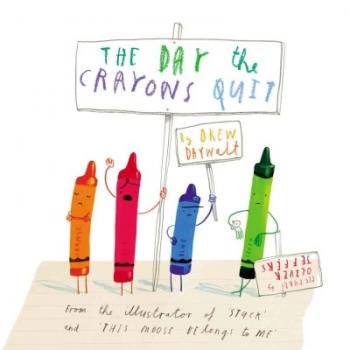
The Day the Crayons Quit is a series of letters to a boy named Duncan. From the crayons in his crayon box.
These colors have feelings. Each has something to complain about. Or lobby for. Or be heard regarding. Even on a fellow crayon’s behalf.
The letters are hilarious. As are the accompanying illustrations by Mr. Jeffers.
Funny enough, three of my very favorite spreads are the less colorful colors in the crayon box. Not sure what that says about me, but I think it’s that the illustrations are that much more creative because the colors aren’t automatically stars.
That swayed beige conveys so much.
 The genius use of negative space for white.
 There’s just something so great about a beach scene starring the very opposite of what you’d imagine. It’s so very French. And an all black rainbow!

Green has only good things to say about its life as a green crayon. Instead, there’s an issue with friends yellow and orange that must be addressed.

 My Blue is Happy takes a look at the associations we have with color. The feelings they give us.
One person’s sad is another person’s happy.
“My sister says that blue is sad like a lonely song. But my blue is happy like my favorite jeans and a splash in the pool on a hot day.”
Orange can be fun like basketball or serious like a tiger.

Brown: ordinary or special as chocolate syrup.

Green: young like new growth, or old as a forest.

It all depends on who’s doing the looking. I like the way this explores comparisons in a natural way and begs the question, “What do you associate with the color ___________?”
Both books could be of great use in an art context, to discuss color theory, or just to enjoy.
/ / / / / / /
Okay, so here’s some fun with COLOR (wheels):

Origami color wheel box by Boston Origami.

Ummmm, gummy bear color wheel!

Color wheel a la LEGO!

Cocktail umbrella color wheel from Bright Lights Little City.

Diem Chau‘s amazing carved crayons.

Animal crayons, anyone?

Finally, there are fun color exercises and optical illusions like this one from We All Sew.The middle squares are all the same color. But see how different they look depending on the background?
To color!


